Monday, 19 September 2016

Composition - putting it all together with care. Student watercolours.

While it may look sometimes that paintings just 'happen' by themselves, the images that we find most pleasing to the eye are those which have been carefully considered and designed by the artist. Unfortunately, in many instances, this vital element in learning to create images is completely ignored. The word used is Composition and without understanding it to some degree, students will prevent their own progress. Without an appreciation of layout and design, the artwork cannot 'sing' and the artist will not have full control of how their artwork is viewed. Composition is just as important for one-off image making as it is for the narrative required in an illustration. 

A cluster of objects looks dauting, until we analyse it 


Good composition engages the viewer and invites them to linger longer. A poor composition feels uncomfortable and won’t encourage the viewer to stay. If you have not considered a picture in terms of ‘feelings’ then now is the time to start. 


Rowan, open and 'clean'
Rose hip - busier-looking because the leaves are broad and overlap.


Students arriving to a table full of berries and leaves is daunting, so in order to begin the task of composing a painting, we took time to consider the make-up of the subject. To do this we looked at individual stems from a variety of plants and noted that the patterns of leaves and berries was very different, and specific to each plant.  Look at the rowan above and notice how the leaves are ‘clean’ and ‘open’, and all come from a small stem off a larger branch. The berries hang in neat clusters at the end, like a hand on the end of an arm. The rose hip is very different. The thick leaves overlap which makes an instant analysis more challenging, but notice how there is great clarity in how the branches are formed - clean prickly stems with one large berry on the end. These observations give us the ‘anatomy’ or ‘design’ of the plant. The act of studying them like this helps us notice design in nature. Now our head is in the right mode! We are thinking about the mechanics of the object, rather than its beauty and understand the way it has been designed.

The students next task was to begin 'thumbnail' pencil sketches to design the layout of their page. They had to include at least two different plants, but the scale did not have to be proportionate. They were allowed only 5 minutes per sketch - this encourages fast thinking, and reduces the layout to the bare bones - in other words, they drew more of the ‘anatomy' of the branches, and were less concerned at this stage with the leaves. If the bare bones work, then it’ll work with the leaves on too! 


Work in progress, which shows lovely use of negative spaces, by student Lorraine L 

Working small allowed them to see how the ‘negative spaces’, the paper which has no drawing on it, are just as important as the drawing itself because the white areas are part of the ‘pattern’ being created. 


Work in progress, a beatiful composition by student Olivia. Rose hips and, under her hand, brambles.
Finally, they chose their favourite composition and drew it onto watercolour paper - partly observing the plant, but remaining totally faithful to their design. This meant that they left out some leaves, but had at all times to observe the anatomy of the plant - how did the stems attach to a larger branch, how does the berry sit with the leaves, etc?  In other words, they designed and created something unique. 
This compostition uses the background to excelent effect, by student Pat F.
You can see from the photos above and below that the result is not something invented, but, rather, designed. 

A triumph of design, by student Hilary J. 


Next up, Belfast workshops for adults in Oil painting, Drawing, Life drawing and Portrait drawing.
Also, occasional children's classes in observation drawing and illustration.

For details email julie@juliedouglas.co.uk or call 07730 560517.


Friday, 1 July 2016

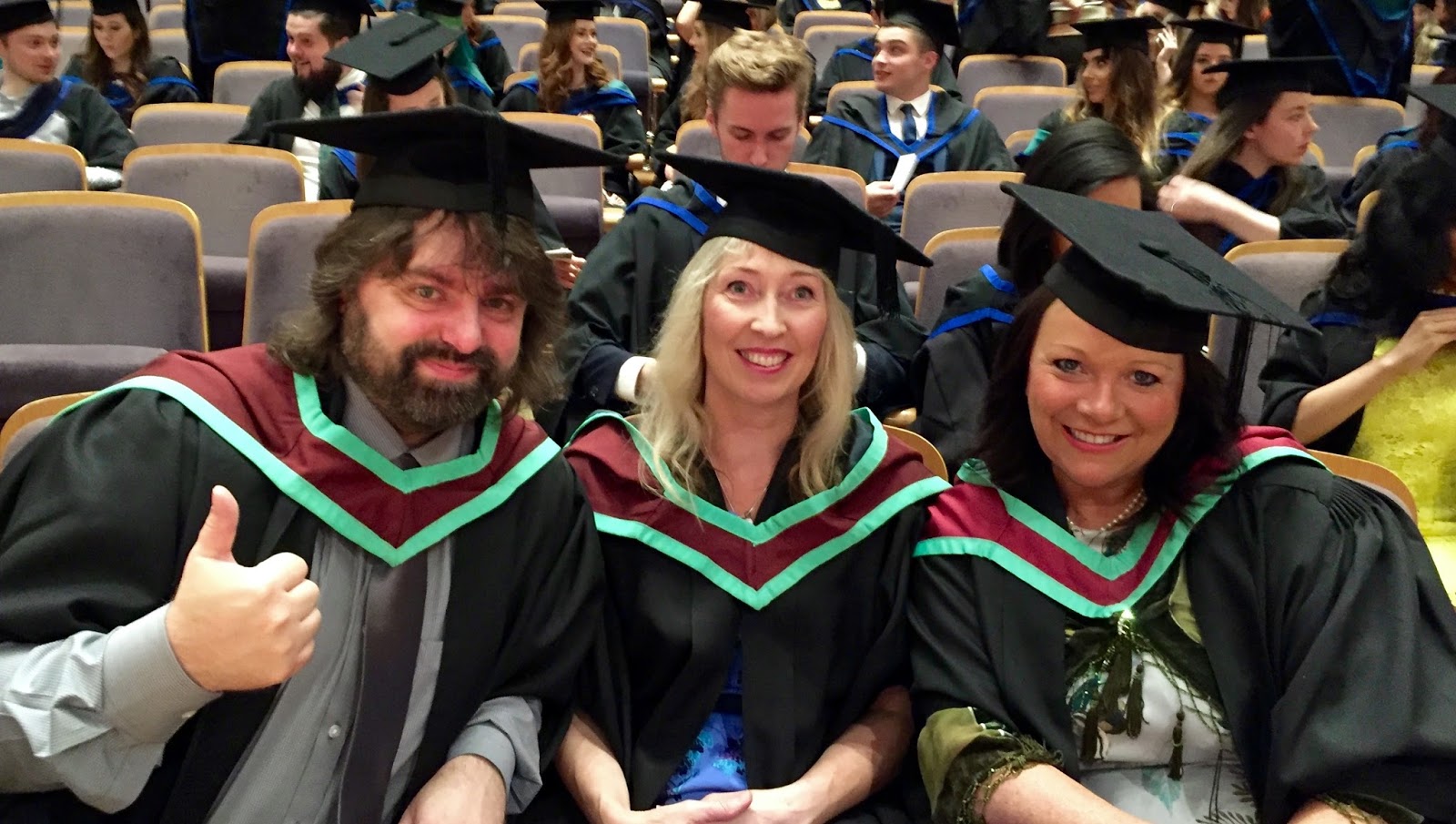
It's official, I'm Mistress of the Arts! A great Day out.

In September 2012 I wrote a post declaring the start of my journey back through college - this time around it was Belfast School of Art, part of Ulster University - to study for a Masters of Fine Art in Multidisciplinary Design.
It's been a much bigger journey than I could have imagined, and during the tough times, I consoled myself with the knowledge that it was my choice and that I could leave it at any time if I wanted. 
It was unusually long for a Masters programme - full time it was a two year course, but after a few weeks I changed to part time, making it a four year commitment. Yikes! 
Me, in the hat, with Debbie Fraser, my tutor 

During that time I read many many books (on business, creative collaboration, psychology, brain development, education, drawing and painting), wrote many presentations and reflective documents (which fill over 20 files), travelled abroad to attend painting workshops in New York, France, Florence and created many public events that would never have happened, outside of the programme. I met my heroes! 

The course was tough. Out of the six students who graduated an amazing FIVE of us were awarded a Distinction. The Northern work ethic is alive and well!! 

Peter Cooper is an amazing Animator and Creature Designer  https://www.facebook.com/petercooperstudio/
Lisa McCausland designed and produced a wonderful new product called Dogease, a post surgical suit to help animal recovery http://www.dogeaseuk.com
Judith Gordon invented a new way for children to learn about money using her app http://www.justmoco.com/about/
Paul McNally is a Graphic Designer who did a massive Kickstarter book project for the Masters, and is now, I'm proud to say, designing my book.
paulmcnallydesign.com 

Slightly wonky shot from the Graduation Programme 


I wrote my thesis on the myths and misconceptions surrounding drawing and painting, to help students get through the difficult times, and am making it available to buy. I made a short film with Paul Marshall called 'Let's Draw!' to encourage everyone to learn to draw, which you can see at this link:    


As well as this I have written a 200 page book called The Weekly Atelier, which is full of tried and tested exercises on drawing and painting, fully illustrated with mine and my students artworks, which is at the design and editing stage at the moment (= agony!) and will be published in the Autumn. 


Draft cover of the book!

On Wednesday this week, we had the formal graduation ceremony and while it was lashing sheets of rain outside, inside the atmosphere was buzzing. 

Peter Cooper, me and Lisa McCausland before the ceremony

Peter Cooper MFAMDD, Julie Douglas MFAMDD, Lisa McCausland MFAMDD 

Celebrating at lunch afterwards with my son Rory 

I'd like to thank my son for putting up with my mountains of books and papers all over the table/piano/living room/kitchen. I'd also like to thank my drawing and painting students for contributing to my research through interviews and discussions, and their moral support. I'd like to thank Debbie Fraser and Christopher Murphy for their inspiring lectures and encouragement, and my fellow students for being there over the past four years. (PHEW!) 

And now I'm back to my drawing board, workshops as usual!


Next up, oil workshop, portrait workshop, location drawing and childrens drawing classes. For info email julie@juliedouglas.co.uk 


Friday, 17 June 2016

Watercolour cornflowers straight from the garden.

There is more than one way to be creative with colour, and one of my very favourite pastimes is looking after (and looking AT!) my garden. I am lucky that it is surrounded by mature trees, giving home to a multitude of birds from Magpies to Wrens and Stonechats. This is the view from my kitchen window this morning, June 2016. The garden is an abundance of greens and is a joy to behold. 

Julne 2016

But when I moved here, the main flower bed was dominated by two enormous Leyandii trees and an overgrown Rhododendron. Two men with lots of elbow grease and axes got rid of those, leaving me with a blank canvas of earth to play with. This photo below was taken in July 2012, four years ago. 
July 2012
As you can see, the ground was covered in ivy and bramble, with a lot of little tree stumps too. After I had dug and cleared those, I had a tonne of manure delivered, to give it all a nutritious treat, then the planting began. 
June 2015
By last year, the garden was a sea of Floxgloves, most of which were taller than me (and I'm 5 Foot 8!). One of the joys of gardening is the way that gardeners share their over-enthusiastic plants.  The Foxgloves were given to me by my friend Liz, so of course I think of her when I see them. In the back of the border are Buddlea and Himalayan Honeysuckle adonated by Glynis and dotted about are geraniums and more, given to me by Joanna. As well as this, I have taken cuttings of many of my own plants when I have moved house, so they become memories which go back a very long way. Many of the plants still growing now are the same ones in photographs of my children, taken in other gardens I have had. The white irises were mature in my garden in East Sussex when I moved there in 1991.. 

My son Christie in the garden in Sussex 1999

In the photo above you can see the Irises at the top left behind Christie's head in 1999 (and Christie is now 22!) and below here they are outside my window today, still going strong.
June 2016


Another plant which moves easily is the cornflower, and if there are enough to cut, I give them to my students to paint. They are lovely in watercolour, with a small amount of drawing on the leaves and straight-to-paint with the blue-purple petals. 


The exercise this time was in getting the right variety and contrast in the colour of the leaves - the back of the leaf is greyish green, and the front is a warm yellow-green. With just two hours to work, the students so really well to get so much done. 

Cornflower watercolour by Barbara, Student

Cornflower watercolour by Pat, student


Upcoming workshops - location drawing in Belfast, Portrait Drawing, Watercolour landscapes and oils. For info please email julie@juliedouglas.co.uk


Thursday, 2 June 2016

Watercolour Painting on Location (bliss) and birthday treats!


When the sun shines in Ireland, there is nowhere more beautiful. Luckily for us, last week my class and I decided that we would visit Mount Stewart, a large estate on the shores of the Ards Peninsula (one of my favourite places on earth), to do some watercolour painting. 

Students settled in on the lawns. 

Loction drawing and painting is good fun, though everyone was very tentative when they started today. I could tell this, because as soon as we arrived, 'someone' said they needed coffee... (a sure sign of great fear about what is to come). I did a head count, and only four were interested, so I did a demonstration painting with the promise of coffee immediately afterwards. This seemed to settle their nerves rightly enough.

There are, it is true, several factors which can make the idea of painting on location seem daunting. It feels different to not have a ceiling above us, and the lack of table is a challenge too. We stomped about while I discussed the various things to look for when choosing a subject, then stood to do my demonstration painting. I kept it simple, and produced a sketch in about 20 minutes. One of the best things about giving a demonstration is to show students what it is to be RELAXED. If we are tense, are drawing will look tense also.

Students getting ready...


The wisest amongst us chose a shady spot
The gardens are full of structure, provided by the main house as well as arbours, trimmed hedges and mature trees. we had plenty of choice.
Neill found a bench for some comfort, and Gavin was happy on the steps.

The first set of artwork, from the morning 
My demo sketches showing different possible approaches (unfinished)


I was about to add colour to this sketch when I was interrupted, for drinks!


Surprise treats!!!
Just as we were finishing up before lunch, Mark began rounding us up, shouting 'Party time!' To my absolute surprise, he and Sara had brought Prosecco and cake, to celebrate my birthday! Drinks on the lawn.. Perfect!
My afternoon watercolour, in progress 
Finished watercolour, straight to paint. Julie Douglas.  
Mark, leaving in STYLE in his fantastic  home made car!


This was just the lovliest day imaginable. Everyone enjoyed painting outside, and we look forward to doing it again soon.

Next up - oil painting workshop, portrait drawing, watercolour and coloured pencil workshops. For info email julie@juliedouglas.co.uk

Wednesday, 1 June 2016

Spring is in the air.. (in the pink!)

It is my great pleasure to collect flowers from my garden to give my students to paint.  I choose subjects according to colour, form, textures, scale and variety on a week to week basis as opposed to 'flowers' or 'portraits', so this basket of Camelia flowers fit the bill nicely for a restricted watercolour painting, with no drawing at all. 

Basket of flowers straight from the garden


While the camelia was the main event, I decided it would be good to warm up with something simpler, with less complicated shapes to get the brushes flowing and relieve any potential anxiety amongst students. 
So we started with a stem of Forest Flame, which has similar colours. Students were then restricted to using only Lemon Yellow, as a base colour, and Alizarin Crimson and Permanent Rose. 

By student, Brigid


Brigid's lovely camelia 

The most important thing to remember when going straight to paint is to resist the temptation to use the brush as if it were a pencil to provide an 'outline'.  The great advantage of NOT drawing an outline in pencil is that we are looking at the entire shape from the offset, as a mass. A line won't do this but a blob of paint pushed over the surface quickly provides the shape we need. 

Trevor starting his Forest Flame 'warm up'
It is a very relaxing way to work and uses watercolour at its best.

Concentrating!

Some students (above) added a background towards the end. 


By student Sara C

By student Jessica


Studying hard!

Trevor's Camelia

Upcoming workshops: oil painting, portrait drawing and children's art!
For information email julie@juliedouglas.co.uk


Friday, 1 April 2016

'Dapples at Scrabo', oil painting 11in x 14 inches on linen.

Some paintings are fast, while others take their time to brew. In this case, I started the painting a few months ago (and documented the drawing stage through to the first layer of colour here  http://juliedouglasdrawingpaintinglearning.blogspot.co.uk/2015/08/portrait-drawing-and-painting-in-oil-in.html ), and had many interruptions in its progress, with commissioned works, lots of teaching sessions and writing my book. However, I did finish it, I think (..but there's always the possiblity of having another visit at some point..), and here it is. It is part of a series of light dapples. I just love light.


sunlight on skin. 


The book is nearly all written - it's about what happens in my weekly workshops, and is full of illustrations of students artworks and demonstrations on how to approach drawing and painting. I can't wait to share it with you, and I"ll keep you posted! 

Upcoming workshop: oil painting 23 & 24 April, Belfast
For info email julie@juliedouglas.co.uk
www.juliedouglas.co.uk


Friday, 25 March 2016

Out and about, drawing at The Ulster Museum Belfast

This week I took my students for a bit of location drawing at the Ulster Museum. This is a wonderful place to draw. While it is certainly a hive of activity, it's large atrium allowing sounds to echo round the building and bounce around the walls, it is (contrary to what you might expect), a welcoming environment and students have no trouble zoning out the noise (or the more curious members of the public), and focusing on drawing.

Standing, L-R, Trevor, Carolyn, Sara. Seated, Mark and myself.

It is good to work away from a desk - being outside our usual comfort zone keeps us fresh and alert and of course the amazing variety of subject matter seems to be endless, from busts to animals to pots, canons, cars, willow sculptures, shells, ceramics and treasure from ship wrecks.

Demo time


Susan, Tony, Margery and Nisa

An extra bonus is the lovely garden which is overlooked by the cafe, so we can draw the trees no matter what the weather is doing. We began with some charcoal drawing, getting a bit messy, which was a good way to warm up and settle in.


Chad -  tree in charcoal
Work by Neill, Peter, Dympna and Karen

Front - back: Chad, Peter (Beaming), Dympna, Karen, Ben, Jackie, Neill
Peter's little sketch book drawing, his first time on location. Great!
And as it was the last day or term, we had to have lunch together, of course!


Lunch!